
Generative AI has made it easier to produce polished, competent knowledge-based outputs and continues to advance. While this creates risks for academic integrity, the case for AI-resilient assessment raises a more consequential question for postgraduate education: what should a master’s degree certify, and what evidence should universities require to support that judgement?
In the first post of our AI-Ready series, we’ll explore how capabilities that create value in an AI-enabled workplace can also strengthen assessment credibility by making human thinking and ownership more visible.
Future-focused workplace skills
Employers expect core skills to change substantially by 2030 as AI becomes embedded in professional practice. AI is ‘raising the skills bar’, not just for generative AI skills, but also higher-level, managerial and ‘human’ skills like communication, problem-solving, and data analysis and interpretation. Though subject-specific expertise remains foundationally important, working with AI creates an increased need for critical thinking capabilities. Alongside disciplinary expertise, postgraduate programmes need to develop the higher-order capabilities that enable graduates to apply knowledge, adapt to uncertainty and exercise professional judgement.
How universities are responding to assessment in the age of AI
Universities have already taken substantial steps to respond to generative AI. However, implementation remains uneven across institutions, schools, modules, and individual academics. In their 2026 State of the Nation report, the QAA found that these differences are creating inconsistent expectations for students and weakening confidence in the evidence used to judge academic standards. Approaches such as blanket restrictions, additional oral vivas and AI-detection tools are also putting further strain on workload, training and resources.
The task, therefore, is not simply to make existing assessments harder for generative AI to complete. It is to design programmes that develop the ‘human’, critical and AI literacy skills to help graduates thrive in an AI-enabled world. Assessment and qualification credibility follows when disciplinary expertise is combined with these future-focused capabilities and made visible in the assessment process. The rest of this AI-ready blog series will examine how universities can put these principles into practice.
AI-ready graduate capabilities
Alongside the specialist knowledge that postgraduate education is traditionally designed to develop, graduates also need capabilities that remain valuable when generative AI can generate high-quality knowledge-based outputs.
Alongside domain-specific knowledge and skills, four key areas are required for success in an AI-enabled workforce:
- Metacognition. Students need to recognise how they learn, monitor whether their strategies are working and adapt them when necessary. This includes deciding when generative AI is helping them extend their thinking and when it is removing the productive challenge needed for durable learning. Research has identified the risk that generative AI efficiency can reduce students’ motivation to think deeply and regulate their own learning.
- Cognitive agency. Cognitive agency means that the student remains the principal thinker and decision-maker. They frame the task, test and question generative AI outputs, decide what to accept or reject, integrate useful contributions with disciplinary knowledge, and take responsibility for the final judgement. This is more demanding than using an AI tool effectively; it requires students to retain intellectual ownership of the work.
- Human-premium, work-ready skills. AI can assist with information retrieval, drafting and pattern recognition, but postgraduate education must continue to develop the human capabilities that create professional value in context. These include analysis, interpretation, reasoning, evaluation, problem-solving, creative thinking and judgement under uncertainty. Students must be able to explain not only what they concluded, but why that conclusion is justified in relation to evidence, constraints and competing perspectives.
- Practical AI skills. Students also need practical, discipline-relevant AI skills. These include selecting appropriate tools, constructing effective prompts, protecting sensitive data, checking outputs against reliable evidence and communicating the role AI has played in their work. These skills are most meaningful when they are developed through authentic disciplinary activity, rather than taught separately from it.
AI-Ready graduate capability framework
Four interconnected capabilities for success in the AI era
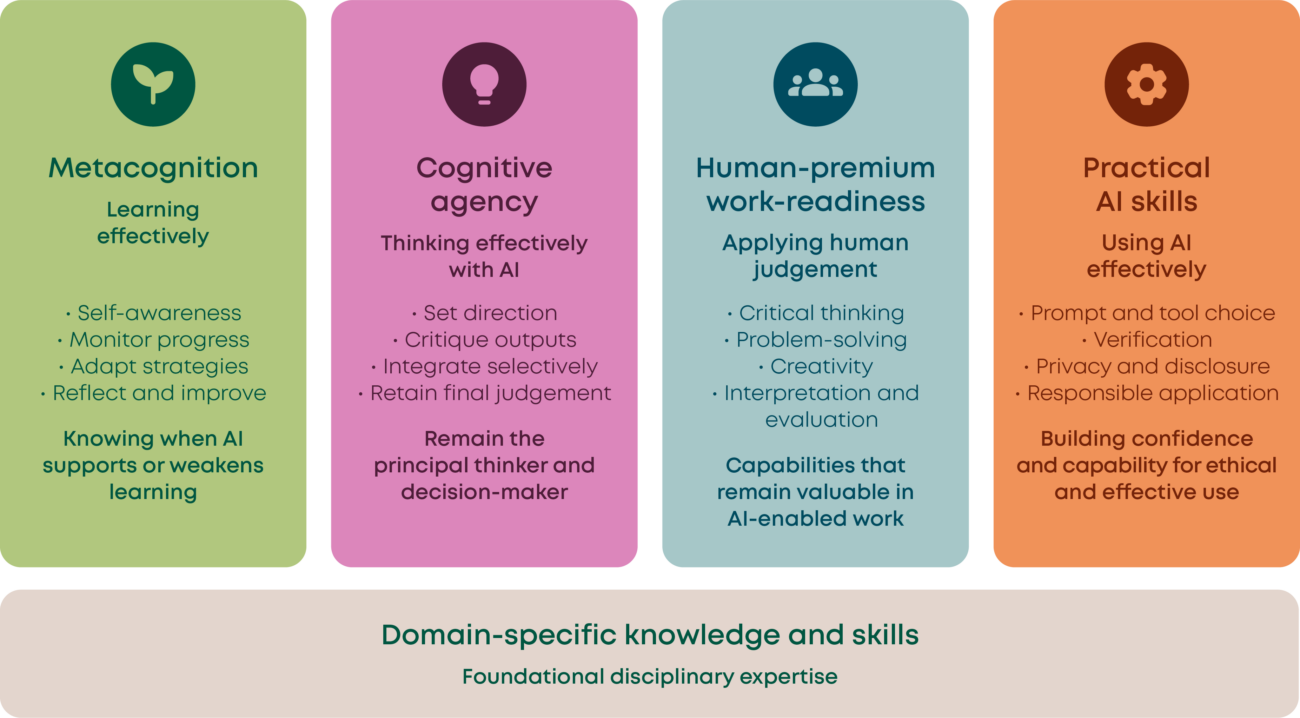
AI-ready capabilities need to be taught, practised and assessed explicitly across the programme. An important aspect of this is designing opportunities for productive struggle: meaningful cognitive challenge that requires students to surface assumptions, test ideas, revise their thinking and work through uncertainty. Generative AI can support this process by providing feedback, alternative perspectives and challenge, as long as it doesn’t replace their critical thinking, judgement and accountability.
When programmes build these capabilities deliberately, students are better prepared for an AI-enabled workplace. This also creates a stronger basis for assessment, because students’ reasoning, development and ownership can be evidenced alongside the quality of their final work.
A framework for AI-resilient assessment
If generative AI can produce the product, the evidence has to include the thinking behind it. Our AI-resilient assessment model helps universities generate more credible evidence of what students comprehend, think and do, whilst recognising and mitigating the risks generative AI presents to authentic assessment. The model strengthens assessment through three complementary approaches, providing a more complete picture of students’ knowledge, judgement and ownership than any one assessment method can provide alone.
Evidence the thinking
Assessment should include appropriate evidence of how the student arrived at a final submission, including planning, research, decision-making, revision and response to feedback. This makes the student’s cognitive journey more visible: how their reasoning developed and what informed their choices.
For example, a learning journal or cognitive portfolio, accessible to the tutor and potentially contributing to the assessment grade, can capture this evidence across a module and programme.
Make capability observable
High-stakes assessments should include selected opportunities for students to demonstrate and defend their knowledge and judgement in real time or under controlled conditions. Viva interviews, presentations with questioning, simulations, demonstrations and live scenarios can provide direct evidence that students can apply what they know.
These approaches are not appropriate for every learning outcome. However, they can require students to explain, perform and defend their decisions where it is clearer whether they can exercise the required capability independently.
Assess human capability
Assessment should test more than the reproduction of knowledge. It should assess the higher-order capabilities that are educationally and professionally important, such as interpretation, reasoning, evaluation, problem-solving, creative thinking, ethical reasoning and judgement under uncertainty.
The three pillars of AI-resilient assessment
Stronger evidence of student capability in the AI era
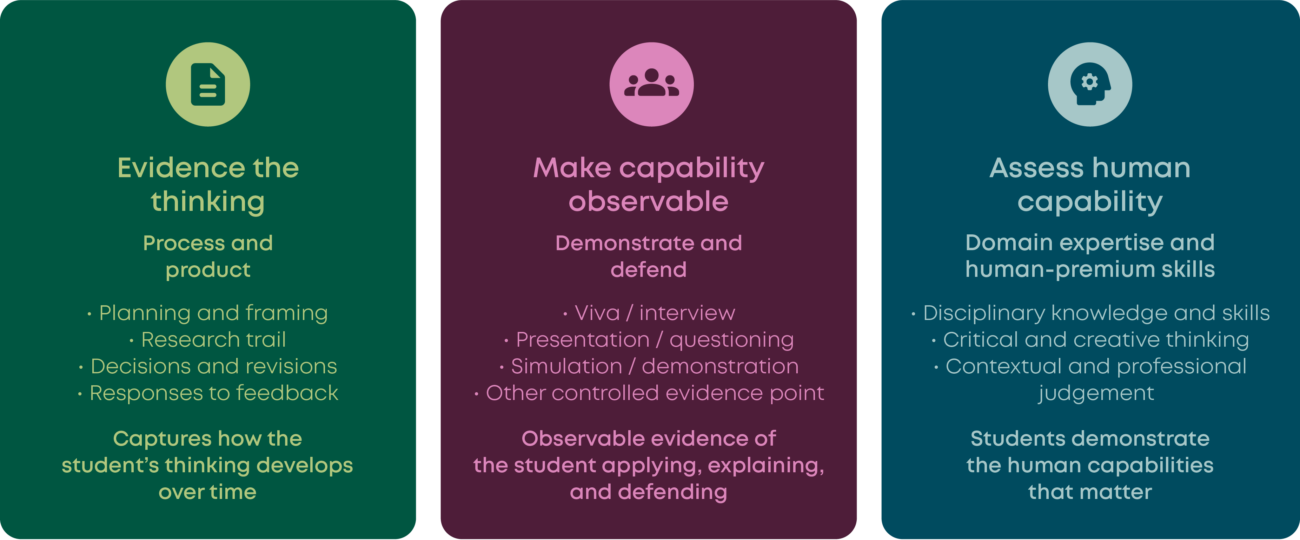
The aim of this approach is to establish whether the student can use disciplinary knowledge and professional experience to make decisions in context, explain their reasoning and respond to challenge, rather than merely devise a test that generative AI cannot answer. Assessment can become part of the learning process itself, helping students practise the judgement and self-regulation they will need beyond graduation and throughout their careers.
A case for evidencing capability and credibility
Generative AI makes it easier for students to create the appearance of achievement without undertaking the learning needed for genuine personal and professional growth. Universities therefore need to embed AI-readiness across the student experience, not treat assessment resilience as a discrete technical problem.
When postgraduate programmes combine disciplinary expertise with cognitive agency, metacognition, human capability and practical AI skills, they better prepare students to thrive in an AI-enabled workplace. They also provide a more credible basis for judging what a qualification represents.
Meeting this challenge will require collaboration between university leaders, educators and industry experts to develop credible approaches that work in practice. We explored these questions in detail with senior university leaders and education technology experts at the Future-Ready Universities Summit hosted by Risepoint in London on 6 October. The discussion examined the distinctive role of universities in an AI-enabled world, how assessment can continue to reflect genuine learning, and how institutions can develop critical thinking, judgement and AI literacy across the student experience.
That conversation continues. In the rest of our AI-Ready series, we’ll move from the case for change to the practical choices universities can make across online postgraduate provision.

